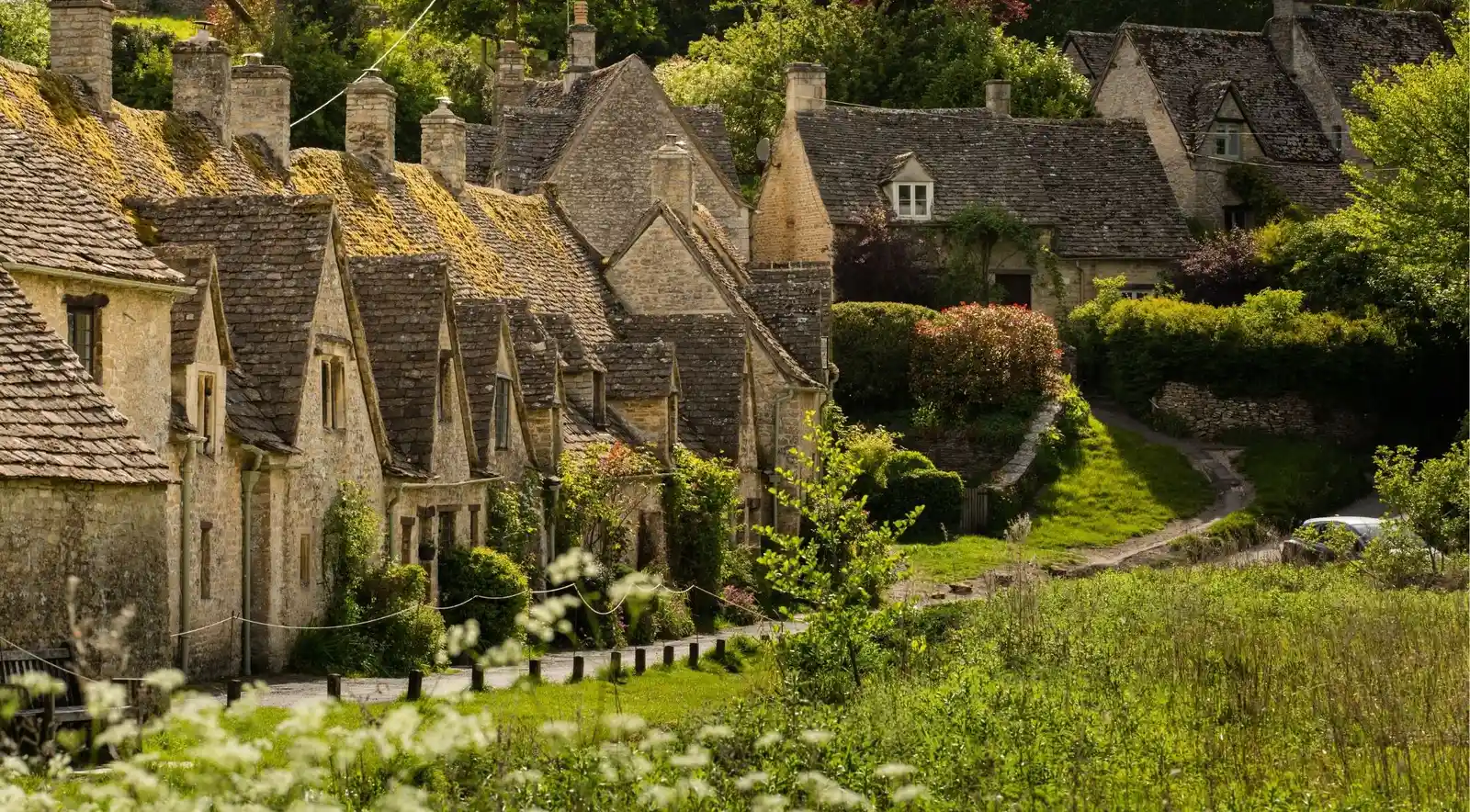
There's a particular kind of magic in swapping London's pavements for honey-stone villages and sheep-dotted hills. The good news? A day trip to the Cotswolds from London is not only possible — it's one of the most rewarding escapes you can make from the capital. Whether you'd rather settle into a small-group minibus, be chauffeured at your own pace in a private car, or lace up your boots for a guided walk, the best Cotswolds tours are built around local expertise and the freedom to explore properly. Below you'll learn exactly how far the Cotswolds are, how to get there, which villages to prioritise, and which tour format suits you best.
Is a Cotswolds day trip from London worth it?
Yes — emphatically. A day in the Cotswolds delivers a concentrated dose of quintessential rural England: golden-stone cottages, sheep-dotted hills, ancient churches and proper country pubs, all within easy reach of London. It's genuinely one of the best days out you can have from the city.
But let's be honest about scale, because most blogs aren't. The Cotswolds National Landscape (still legally an Area of Outstanding Natural Beauty) covers 787 square miles (2,038 km²) — the largest National Landscape in the UK, extended to its current size in 1990. It stretches roughly 90 miles north to south, from just below Stratford-upon-Avon to the outskirts of Bath, and around 25 miles at its widest. You will not "see the Cotswolds" in a day, and anyone promising otherwise is overselling. A realistic, enjoyable day covers two or three villages with time to wander, have lunch and take photographs — not a frantic checklist. That candour is exactly why it pays to plan the day well: better to savour Bibury than glimpse it through a coach window.
How far is the Cotswolds from London?
The Cotswolds sit roughly 80 to 100 miles north-west of London, depending on which village you're heading for. By road it's around two to two-and-a-half hours via the M4 or M40. By rail it's surprisingly quick: London Paddington to Moreton-in-Marsh takes just 1 hour 24 minutes on the fastest direct Great Western Railway services; Paddington to Charlbury runs around 1 hour 10 minutes; Paddington to Kemble roughly 1 hour 6 minutes; and London Marylebone to Banbury in as little as 56 minutes with Chiltern Railways.
What does that mean for planning? The journey is the easy part. Trains run frequently and directly, so the real question isn't whether you can reach the Cotswolds in a day — you comfortably can — but how you want to spend your time once the motorway and mainline give way to single-track lanes. The villages are spread across winding country roads where the mileage between stops is modest but the driving is slow, so a little local knowledge goes a long way.
Getting to the Cotswolds from London
There are four main ways to make the trip — small-group minibus or coach, private car and driver, train with a local guide, or on foot — and each suits a different kind of traveller.
By small-group minibus or coach
For most visitors, a small-group tour is the sweet spot. You're collected from central London, so there's no hire car, no navigating unfamiliar lanes and no hunting for parking in villages where spaces vanish by mid-morning. An expert driver-guide handles the logistics and fills the journey with history and insider tips you won't find on a map. Because seats are limited and these trips are popular, they fill up fast — booking early is strongly advised, especially in summer and over weekends.
By private car and driver
If you want the day shaped entirely around you, a private car and driver is the answer. You set the pace and the itinerary, and you can change your mind en route. It's ideal for families travelling with young children, couples marking a special occasion, or anyone who values flexibility and a little discretion. Your chauffeur takes care of the driving while you enjoy the scenery, and bespoke stops — a particular garden, a specific pub, a village a friend recommended — can usually be arranged.
By train and local guide
Travelling out by train and meeting a local guide on arrival gives you the best of both worlds: the independence of going under your own steam, with the depth of a guided experience on the ground. Moreton-in-Marsh and Kemble are the two main gateway stations, both a short, scenic ride from Paddington, and your guide can meet you right at the platform. It's a particularly good option for solo travellers who want company and expertise without committing to a full coach.
On foot — walking tours
For those who want to feel the landscape rather than just photograph it, nothing beats walking. The Cotswolds are laced with footpaths, the most celebrated being the Cotswold Way, a 102-mile (164 km) National Trail running between the market town of Chipping Campden and the city of Bath, inaugurated in 2007. You don't need to tackle the whole thing — guided countryside walks cover beautiful, manageable sections through meadows, beech woods and village greens, with seasonal highlights from spring wildflowers to autumn colour. It's the most immersive way to experience the region for active travellers.
Our Cotswolds day trips from London
Three core formats each have their own character, so you can match the day to the kind of traveller you are.
Small-group Cotswolds tours
The headline benefit is simple: groups stay small. With a maximum of around 16 passengers, minibuses reach the narrow lanes and tucked-away hamlets that 53-seat coaches physically cannot enter. That means flexible stops, genuine local commentary you can actually hear, and an intimate, unhurried feel — closer to a day out with a knowledgeable friend than a mass-market excursion. The most-booked small-group Cotswolds tour from London is a standout, with thousands of five-star reviews.
Private Cotswolds tours from London
A private Cotswolds tour is tailored entirely around you, from pickup at your hotel or a central London address. It's the natural choice for families with young children who need a flexible rhythm, for honeymooners, or for milestone birthdays and anniversaries. Stops are curated to your interests — photography, gardens, food, history, literary connections — and the itinerary bends to your wishes rather than the other way around. Priced per group, it's also the most comfortable, step-free way to travel.
Cotswolds walking tours
Walking tours are for active travellers who want to feel the landscape underfoot, not just see it through glass. You'll walk at a comfortable, conversational pace along footpaths, across meadows and through village greens, with a guide who knows the terrain and its stories. Itineraries shift with the seasons to make the most of whatever the countryside is doing — bluebells and lambs in spring, golden light and harvest hedgerows in early autumn.
Small group, private, or walking — which is right for you?
Choosing between the three comes down to how you like to travel, the size of your party and the pace you're after. Here's a quick comparison to help you decide.
| Tour type | Group size | Flexibility | Best for |
|---|---|---|---|
| Small group | Up to ~16 | Set route, flexible stops | Solo travellers, couples, value-conscious visitors who want expertise and company |
| Private car | Your party only | Total — fully bespoke | Families, special occasions, those wanting privacy and control |
| Walking | Small guided group | Route-led, seasonal | Active travellers, nature lovers, photographers |
In short: choose a small-group tour if you want expert commentary, sociable company and excellent value; a private tour if you want complete control and a day built around your party alone; and a walking tour if the landscape itself is the main event and you'd rather earn your cream tea.
Which Cotswolds villages will you visit?
Most first-time visitors want to see the "classic four" — Bibury, Bourton-on-the-Water, Stow-on-the-Wold and Burford — and with good reason: each captures a different facet of the region.
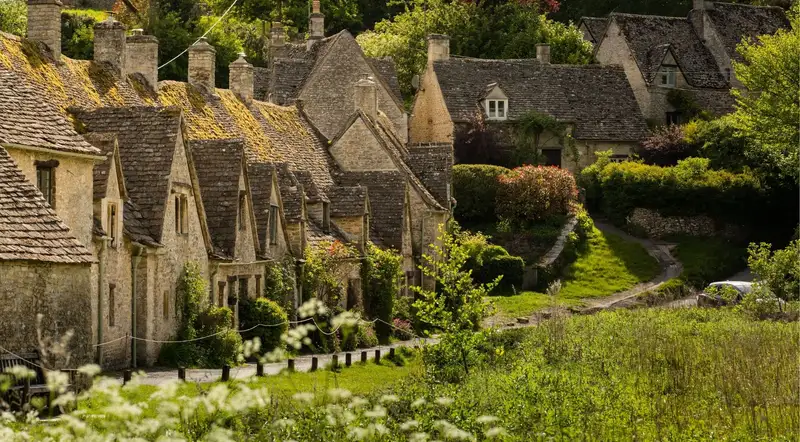
Bibury
In a letter of 8 August 1880, the Arts and Crafts pioneer William Morris wrote that "Bibury is surely the most beautiful village in England," and the description has stuck for well over a century. Its centrepiece is Arlington Row, a line of weavers' cottages built around 1380 as a monastic wool store and converted to homes in the 17th century — a scene so iconic it has appeared on the inside cover of British passports. Across the water meadow known as Rack Isle, the ivy-clad Swan Hotel reflects in the River Coln, and the village is home to Bibury Trout Farm, one of England's oldest, founded in 1902. A tip: come early. The light is softest in the morning and crowds are thinnest before about 10am.
Bourton-on-the-Water
Known as the "Venice of the Cotswolds," Bourton-on-the-Water is built around the gentle River Windrush, crossed by a series of low, arched stone bridges that give the village its nickname. It's wonderfully family-friendly, with attractions including the Model Village — built between 1936 and 1940 at 1:9 scale and itself Grade II listed — and Birdland Park, home to penguins, flamingos and birds of prey. It's deservedly popular, so timing matters: arrive early or later in the afternoon to enjoy it at its most relaxed.
Stow-on-the-Wold
The highest of the Cotswold towns, Stow-on-the-Wold rewards visitors with one of the region's most photographed sights: the north door of St Edward's Church, flanked by two ancient yew trees and widely said to have inspired J.R.R. Tolkien's Doors of Durin. Just off the broad market square sits The Porch House, whose timbers have been carbon-dated to around 1000 AD and which is often promoted as England's oldest inn. Antiques shops, galleries and cosy cafés line the square, and Stow's central position makes it an excellent base for the surrounding area.
Burford
Often called the "Gateway to the Cotswolds," Burford greets you with a steep high street of honey-stone shops, tearooms and antique dealers sweeping down towards the River Windrush. The Grade I listed Church of St John the Baptist carries a poignant Civil War history, while the half-timbered Tolsey Museum — once the medieval market and toll house built in the early 1500s — tells the story of the town's wool-trade prosperity. The Bull Hotel and a string of pubs and bakeries make Burford a natural lunch stop.
Hidden gems — where larger coaches can't go
This is where small-group travel truly earns its keep. Beyond the famous four lie the Slaughters — Upper and Lower Slaughter, twin villages connected by a mile-long riverside path along the River Eye — plus the atmospheric 15th-century ruins of Minster Lovell on the Windrush, and Snowshill, a hillside village with its eccentric, treasure-filled National Trust manor. These places sit at the end of narrow lanes that big coaches simply cannot navigate, which is precisely why smaller vehicles can take you there while the crowds stay behind.
Visiting the Cotswolds from Oxford
Oxford makes an ideal starting or ending point for a Cotswolds visit, sitting just 20 to 30 miles from the southern and eastern edges of the region. If you're already spending time in the city of dreaming spires, the connections are excellent: trains from Oxford reach Charlbury, right on the edge of the Cotswolds, in around 16 minutes. That makes it easy to combine a day among the colleges with a day among the villages — many visitors choose exactly this pairing, and a combined Oxford and Cotswolds tour links the two seamlessly. For more options across the capital's countryside and heritage, see our guide to the best day trips from London.
When is the best time for a Cotswolds day trip?
Every season has its charm, but some months edge ahead. May and June bring wildflower meadows, warm evenings and the landscape at its lushest, before peak crowds arrive. July and August are the busiest and priciest months, with the warmest weather but the most congested villages — book well ahead. September is arguably the best month of all: the light turns golden, school holidays end so crowds thin, and a harvest atmosphere settles over the countryside, with average highs around 18°C. October delivers spectacular autumn colour and morning mist in the valleys, and winter is quiet, frosty and atmospheric, with cosy pub fires.
Whatever the month, pack sensibly: comfortable, waterproof walking shoes, layers, a waterproof jacket regardless of the forecast, and a camera. A bright Cotswolds morning can turn to drizzle by lunch and back again — it's England, after all.
Want more time? Overnight and 2-day Cotswolds tours
Some guests arrive for a day and immediately wish they had longer — and the Cotswolds genuinely reward a second day. With more time you can slow right down: explore both the northern and southern reaches of the region, linger over a long pub lunch, and experience the villages in the magical quiet of early morning and evening, once the day-trippers have gone. A two-day trip also opens the door to combining the Cotswolds with nearby highlights such as the Georgian city of Bath, at the southern end of the Cotswold Way, or Shakespeare's Stratford-upon-Avon, just north of the AONB boundary.